
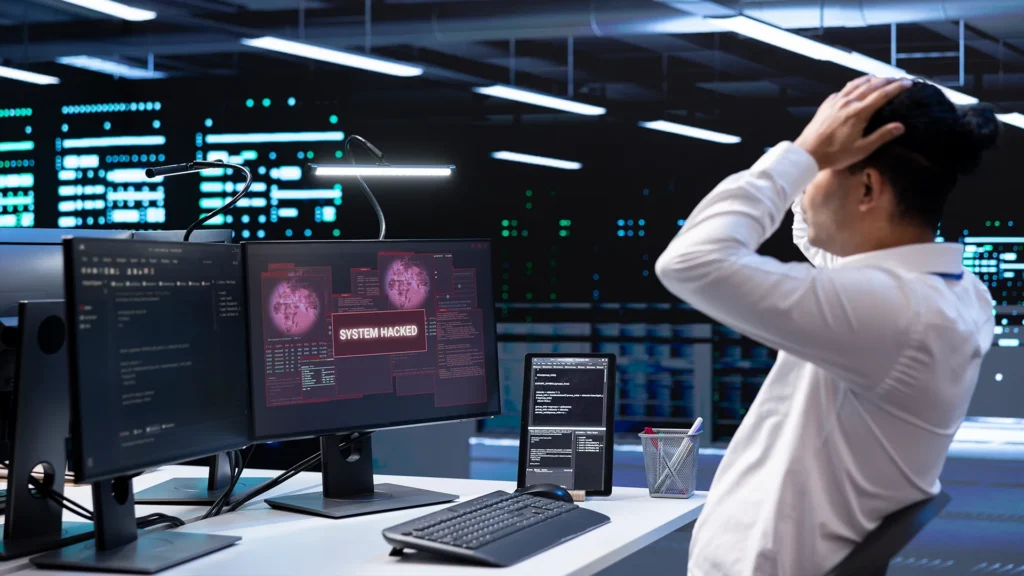
Technology evolves. Attacks do too. But the target remains the same: people.
Technology is evolving at an unprecedented pace. New solutions, more robust architectures, artificial intelligence applied to defense. On paper, we have never been more protected.
But attackers evolve as well. And they do so with a key advantage: they don’t need to break every system, they just need to find one open door.
Today, that door is no longer purely technical. It’s human.
While organizations strengthen their infrastructures, attackers have understood something fundamental: it is easier to manipulate a person than to breach a well-protected system. A convincing email, a seemingly legitimate call, a message that creates urgency… and security breaks from within.
The reality is uncomfortable, but clear: the target remains the same. It’s not the network. It’s not the software. It’s the people making decisions within it.
Context: When the attack becomes psychological
For years, cybersecurity focused on protecting perimeters. Firewalls, antivirus, access controls. Everything designed to stop external threats trying to break in.
Today, that paradigm has shifted.
Organizations have significantly increased their investment in security technology, raising technical barriers and making traditional attacks more difficult. But this hasn’t stopped attackers. It has made them more strategic.
Instead of attacking systems, they now attack behaviors.
They use artificial intelligence to create highly personalized emails that are nearly impossible to detect. They replicate executives’ voices to give false instructions with full credibility. They generate manipulated videos that simulate real scenarios. They design situations meant to pressure, confuse, or build trust.
The goal is no longer to find a vulnerability in code. It’s to find a vulnerability in decision-making.
And this is where many organizations still underestimate the risk.
Because while technology gets stronger, the human factor remains the most exposed point. Not due to lack of capability, but because it hasn’t always been prepared for this new type of threat.
Cybersecurity is no longer just a technical challenge. More than ever, it is a human one.
Problem: The easiest access point is not the system, it’s the mind
Today, the human element has become the most effective entry point for attacks. Not because of a lack of tools or investment, but because of the sophistication of modern threats.
Attackers no longer send generic emails or rely on obvious tricks. They craft tailored attacks. They use AI to create hyper-personalized messages, clone executive voices to issue urgent instructions, generate deepfakes that simulate real meetings, and design highly detailed impersonation schemes.
The result is a threat that blends seamlessly with reality.
What was once detectable through basic intuition now requires a level of analysis that is often unrealistic in the pace of day-to-day work. Because these attacks don’t look like attacks. They look like business, urgency, legitimate decisions.
And that’s the problem: when the fake feels real, traditional defenses lose effectiveness.
Insight: The real battlefield is decision-making
The problem is no longer purely technological. It is cognitive.
Modern attacks don’t aim to break systems; they aim to influence people. They are designed to exploit how we think, how we react, and how we make decisions under pressure.
They appeal to trust when they appear to come from a leader.
To urgency when they demand immediate action.
To routine when they blend into everyday processes.
They don’t attack from the outside. They infiltrate the internal logic of the organization.
This completely shifts the cybersecurity approach. Because it’s no longer enough to block access or detect technical anomalies. Now, it’s essential to prepare people to recognize manipulation patterns, question what seems obvious, and act with judgment—even in ambiguous situations.
In this context, security becomes as much a mental capability as it is a technological one.
Tension: The breaking point is minimal
In cybersecurity, the margin for error is almost nonexistent.
A single click on a malicious link.
A transfer approved without proper validation.
A credential shared at the wrong moment.
That’s all an attacker needs.
It doesn’t require multiple failures or major breaches. Just one decision, made in seconds, can open the door to an incident that quickly escalates across the organization.
And that’s where the magnitude of the risk becomes clear: while defense is complex and layered, the attack can depend on a single moment.
That’s why the difference between being protected and being exposed is not always the technology in place, but the ability of people to pause, question, and act with judgment at the right time.
Value Proposition: Turning users into an active line of defense
Security can no longer rely solely on firewalls, antivirus, or detection tools. While necessary, that approach is not enough against threats that target decisions rather than systems.
The real evolution lies in integrating people as an active line of defense.
This goes beyond one-time training sessions or static policies. It requires building a continuous awareness model where every employee understands real risks, recognizes warning signs, and knows how to respond to increasingly sophisticated attack scenarios.
Ongoing training, real-world attack simulations, and embedding security into daily culture allow users to move from being the weakest link to becoming an intelligent filter against threats.
Because when people are prepared, attacks lose effectiveness.
Strategic Approach: Making security an organizational habit
Building a security culture is not a project—it’s a process.
It requires integrating cybersecurity into how the organization operates, decides, and communicates. Not as an obligation, but as a shared responsibility.
Every employee, regardless of role, must understand that they are part of the defense system. That their decisions have a direct impact on the organization’s security.
This happens when security is no longer confined to IT and becomes an organizational behavior. When questioning, validating, and reporting are no longer exceptions, but habits.
The goal is not to create fear, but judgment. Not to slow down operations, but to make them more conscious and secure.
Key Benefits: When culture reduces risk
When people become an active part of the security strategy, the impact is tangible across the organization.
Incidents caused by human error decrease significantly, as employees recognize threats before interacting with them.
Early detection improves, as users evolve from being the last line of defense to becoming distributed sensors across the organization.
Teams become more resilient to advanced threats, capable of responding with judgment even in high-pressure or ambiguous situations.
And overall, the organization’s security posture strengthens—not only through technology, but through collective behavior.
Because a conscious organization is, by definition, a harder target to attack.
Closing: The real firewall is human
Security doesn’t start with technology. It starts with the decisions people make every day.
In a world where attacks are increasingly sophisticated, the difference is not who has more tools, but who has better judgment.
At Bigfive, we understand that the human factor is not a weakness to fix, but a strength to develop. That’s why we help organizations turn their people into the first line of defense: aware, prepared, and capable of stopping threats before they become incidents.
Because in the end, the best protection is not the one that reacts—it’s the one that prevents the attack from succeeding.
 ES
ES  US
US